Flush Times and Fever Dreams by Joshua D. Rothman
Author:Joshua D. Rothman
Language: eng
Format: epub
ISBN: 978-0-8203-4466-9
Publisher: University of Georgia Press
Published: 2012-11-01T00:00:00+00:00
V.
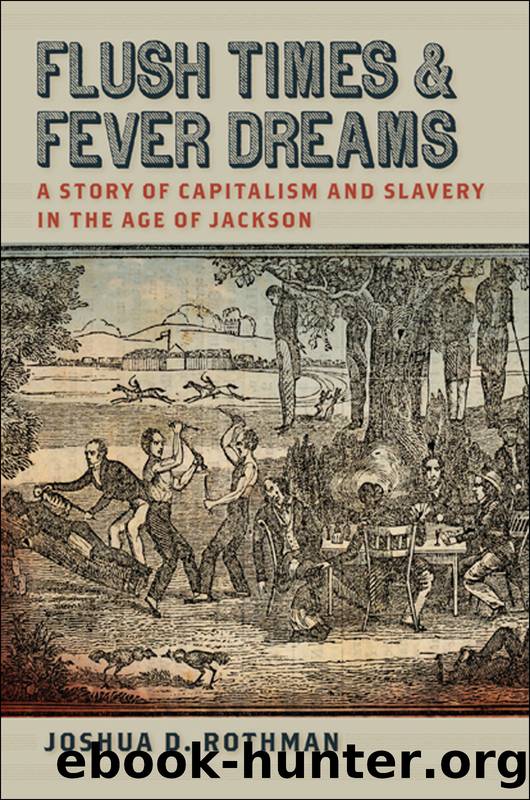
One person who did not understand what was happening in Mississippi was the Reverend Duke W. Hullum, who followed events in Vicksburg as closely as he could from his home in Hardeman County, Tennessee. His son John was one of the four men trapped in Truman Northâs Vicksburg Coffee House on July 6. Shot several times as the mob launched its final assault, and insensible to his ultimate fate, he had been noosed and thrown unconscious from the gallows. The elderly Rev. Hullum grieved and waited for some indication that members of the mob would be tried for their roles in his sonâs death. Surely they could not get away with murder. But late in September 1835, having neither seen nor heard any sign that officials in Mississippi intended to take action, Hullum wrote a letter to Mississippi governor Hiram Runnels and released the text of it to the press, where it appeared first in the Liberty Hall and Cincinnati Gazette before being reprinted in papers all across the country.51
Hullum wanted Runnels to do his job. Virtually every newspaper in America had published reports of what had transpired in Vicksburg. Surely Runnels had heard and read enough to be convinced that known killers were walking the streets of the city with impunity. Yet he had done nothing about it and seemed content to continue to do nothing about it, putting Hullum in the flabbergasting situation of having âto ask that justice as a favor which the laws of my country entitle me to demand as a matter of right.â52
Hullum saw nothing complicated or unclear in the circumstances surrounding his sonâs death. John Hullum had been inside a house. He had been charged with no crime, and no warrant had been issued for any legal authority to enter the premises. A mob had surrounded the house, and those inside had warned that they would shoot at anyone who approached the building. The mob attacked the house anyway, John Hullum opened fire in self-defense, and he had consequently been hanged without ever seeing a jury or a courtroom. Duke Hullum told the governor that he would have come to Mississippi himself to help prosecute his sonâs executioners but had been cautioned that he would be killed if he tried to do so. âThis,â Hullum wrote to Runnels, âis an alarming state of society, and which, if not shortly corrected by an energetic and efficient administration of the laws, we may bid adieu to liberty and justice, the wisdom and purity of our boasted institutions, and all those constitutional rights and privileges which are the pride and glory of every virtuous American citizen.â53
Duke Hullum recognized that the question of whether his son had been a âvirtuousâ American citizen was at least partially at issue because it was âalleged he was a gambler.â As a minister, the elder Hullum offered no extenuation for what may or may not have been the vices of the younger. To Duke Hullum, gambling was âa great and growing evil, and should receive the pointed reprobation of the civilized world.
Download
This site does not store any files on its server. We only index and link to content provided by other sites. Please contact the content providers to delete copyright contents if any and email us, we'll remove relevant links or contents immediately.
The Vikings: Conquering England, France, and Ireland by Wernick Robert(84528)
Ali Pasha, Lion of Ioannina by Eugenia Russell & Eugenia Russell(40375)
The Conquerors (The Winning of America Series Book 3) by Eckert Allan W(38733)
The Vikings: Discoverers of a New World by Wernick Robert(37043)
Cecilia; Or, Memoirs of an Heiress — Volume 1 by Fanny Burney(32708)
Cecilia; Or, Memoirs of an Heiress — Volume 2 by Fanny Burney(32072)
Cecilia; Or, Memoirs of an Heiress — Volume 3 by Fanny Burney(32054)
Empire of the Sikhs by Patwant Singh(23183)
The Secret History by Donna Tartt(19436)
Hans Sturm: A Soldier's Odyssey on the Eastern Front by Gordon Williamson(18706)
Cat's cradle by Kurt Vonnegut(15525)
Pimp by Iceberg Slim(14774)
Sapiens: A Brief History of Humankind by Yuval Noah Harari(14536)
Norse Mythology by Gaiman Neil(13537)
Talking to Strangers by Malcolm Gladwell(13516)
Leonardo da Vinci by Walter Isaacson(13471)
4 3 2 1: A Novel by Paul Auster(12598)
Underground: A Human History of the Worlds Beneath Our Feet by Will Hunt(12217)
The Radium Girls by Kate Moore(12165)
